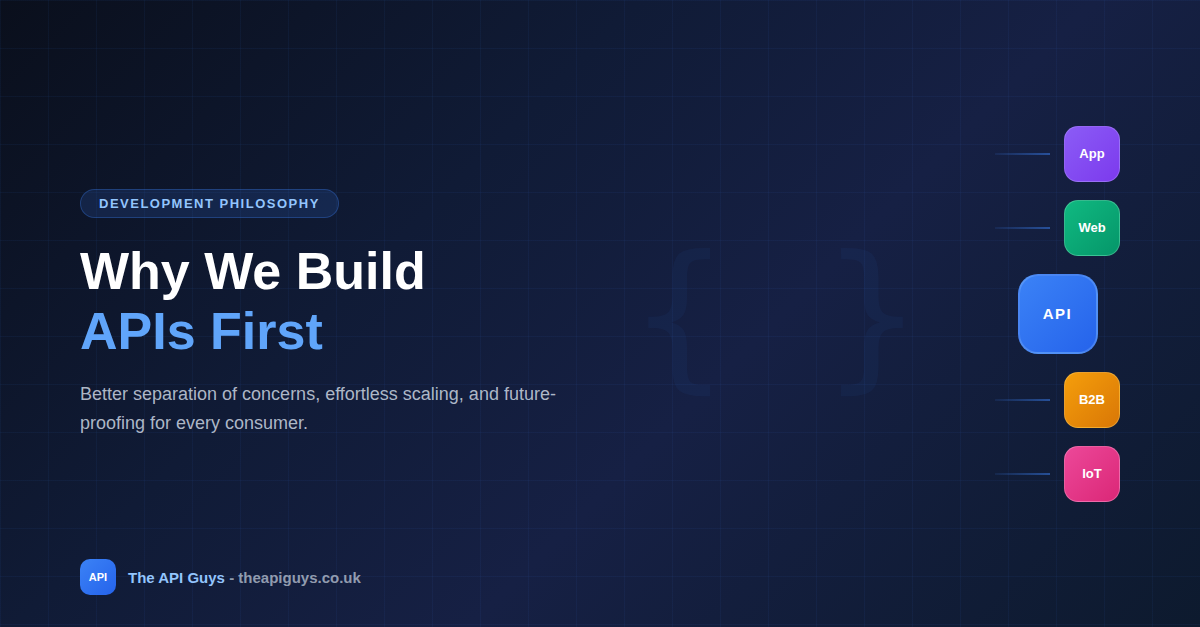
Why We Build APIs First
When we start a new project, the first thing we build is the API. Not the frontend. Not the admin panel. The API. It is the foundation that everything else sits on top of, and getting it right early makes everything that follows simpler, faster, and more resilient.
This is what we mean by "API-first" development, and it is the approach we take on every project at The API Guys. Here is why we think it matters.
What does API-first actually mean?
API-first means treating your application's API as a first-class product rather than an afterthought. Instead of building a monolithic application and then bolting on an API later, you design and build the API layer before any frontend or consumer touches it.
In practical terms, this means your business logic, data validation, authentication, and core workflows all live behind a clean, well-documented API. The frontend - whether that is a React application, a mobile app, or a third-party integration - simply consumes that API.
Better separation of concerns
One of the biggest advantages of building APIs first is the clean separation it creates between your backend logic and your presentation layer. Your API handles the "what" - what data is available, what actions can be performed, what rules govern those actions. Your frontend handles the "how" - how that data is displayed, how users interact with it, how it looks and feels.
This separation has real, practical benefits. Your backend developers can work on API endpoints without waiting for frontend designs to be finalised. Your frontend developers can build against a documented API contract without needing the backend to be complete. Both teams move faster because they are not stepping on each other's toes.
In our Laravel projects, this means our API routes, controllers, form requests, and resources are all purpose-built for delivering data. There is no mixing of Blade templates with business logic or coupling view concerns to database queries. Everything is clean, testable, and predictable.
Easier to scale
When your API is a standalone layer, scaling becomes significantly more straightforward. You can scale your API servers independently of your frontend. You can introduce caching at the API level without worrying about how it affects server-side rendering. You can put a CDN in front of your frontend whilst your API handles the dynamic workload behind the scenes.
This matters as your application grows. A monolithic application that serves both HTML and data often hits scaling bottlenecks because everything is competing for the same resources. With an API-first architecture, you can identify exactly where the pressure is and scale that specific layer.
Laravel makes this particularly manageable. With built-in support for queues, rate limiting, and caching - combined with tools like Laravel Octane for high-performance serving - you have a robust toolkit for building APIs that handle serious load without breaking a sweat.
Future-proofing for multiple consumers
This is where API-first development really pays dividends. When your API is the single source of truth, adding new consumers is trivial.
Today you might only need a web application built in React or Next.js. But six months from now, the business wants a native mobile app. A year after that, a key partner wants to integrate directly with your platform. With an API-first approach, all of these consumers use the same API. You do not need to rebuild your business logic for each new channel.
We have seen this play out time and again with our clients. A project that starts as a simple web application grows into a platform with mobile apps, webhook integrations, partner APIs, and internal tooling - all powered by the same Laravel API we built on day one. The upfront investment in getting the API right saves enormous amounts of time and money down the line.
Better testing and reliability
APIs are inherently easier to test than full-stack applications. Every endpoint has a defined input and an expected output. You can write comprehensive automated tests that verify your business logic without needing to spin up a browser or simulate user interactions.
In Laravel, we lean heavily on feature tests that hit our API endpoints directly. We test authentication flows, validation rules, authorisation policies, and edge cases - all through the API. This gives us confidence that the core of the application works correctly, regardless of which frontend is consuming it.
When something goes wrong in production, debugging is also simpler. You can isolate whether the issue is in the API or the frontend, check the API response directly, and pinpoint the problem without wading through layers of tightly coupled code.
A better developer experience
Building APIs first also creates a better experience for everyone working on the project. New developers joining the team can read the API documentation and understand what the application does without needing to trace through frontend code. Third-party developers integrating with your platform get a clean, consistent interface to work with.
We document our APIs thoroughly - typically using OpenAPI specifications - so that any consumer, whether internal or external, knows exactly what is available and how to use it. This documentation becomes a living contract that keeps everyone aligned.
How we approach it at The API Guys
Our typical workflow starts with API design. We work with our clients to understand the domain, map out the resources and relationships, and define the endpoints that will power the application. We use Laravel to build the API with a focus on clean architecture - resource controllers, form request validation, API resources for consistent response formatting, and comprehensive test coverage.
Once the API is solid, the frontend team builds against it. For most projects, that means a React or Next.js application that consumes the API. Because the API contract is already defined, frontend development can often run in parallel with backend refinements.
This approach works whether we are building a new platform from scratch, modernising a legacy system, or adding API capabilities to an existing application. The principle is always the same: get the API right first, and everything else follows.
Is API-first right for every project?
For the vast majority of web applications, yes. If there is any chance your application will need to serve more than one type of consumer - and there almost always is - then building API-first is the pragmatic choice. Even if you only ever have a single web frontend, the separation of concerns and testability benefits make it worthwhile.
The only scenario where it might add unnecessary complexity is a genuinely simple, static site with no dynamic data. For everything else, we would always recommend starting with the API.
If you are planning a new project or looking to modernise an existing one, we would love to chat about how an API-first approach could work for you. Get in touch and let's talk.