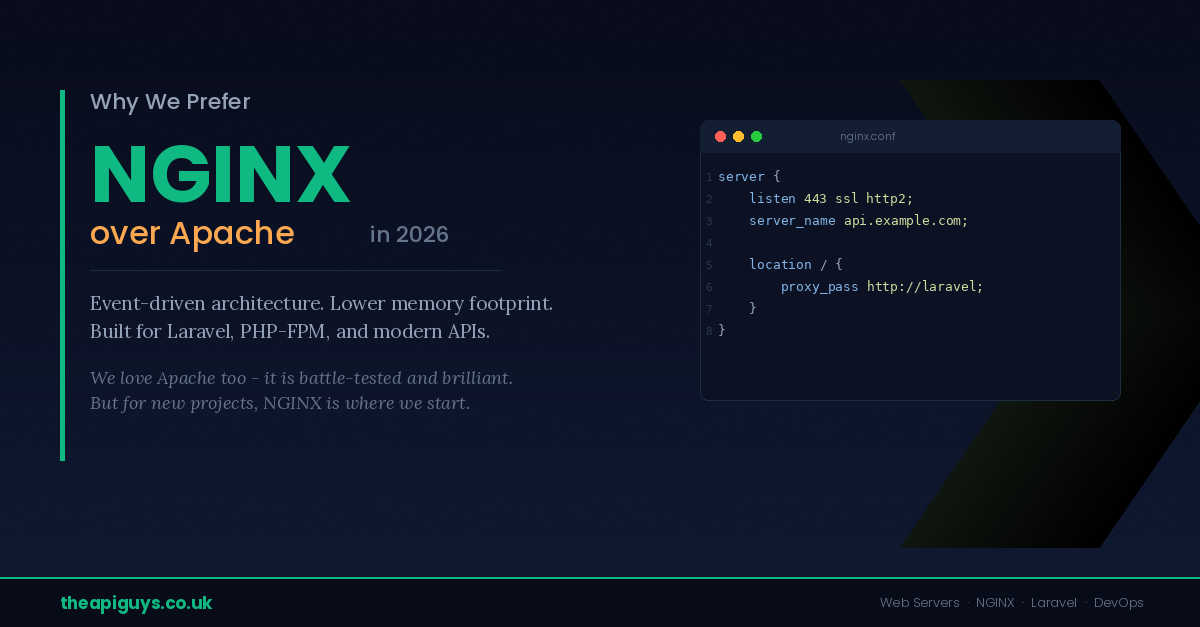
Why We Prefer NGINX Over Apache in 2026
If you have spent any time in web development, you will have come across the two heavyweights of the web server world: NGINX and Apache. Both have powered the internet for decades, and both continue to do so in 2026. We genuinely love Apache - it is a brilliant piece of software that has shaped the web as we know it. But when it comes to our day-to-day work building APIs and web applications with Laravel, NGINX is our clear preference.
Here is why.
Architecture That Suits Modern Workloads
The fundamental difference between NGINX and Apache comes down to how they handle connections. Apache traditionally uses a process-driven model, spawning a new process or thread for each incoming connection. NGINX, on the other hand, uses an event-driven, asynchronous architecture where a single worker process can handle thousands of concurrent connections without breaking a sweat.
For the kind of work we do - building RESTful APIs, handling webhook traffic, and serving Laravel applications that might see unpredictable traffic spikes - this architectural difference matters. NGINX handles high concurrency with significantly lower memory consumption, which means our servers stay responsive even when things get busy.
A Natural Fit for Laravel and PHP-FPM
Laravel is our primary framework, and the NGINX plus PHP-FPM combination has become the gold standard for deploying Laravel applications. The separation of concerns is clean: NGINX handles the HTTP layer brilliantly, serving static assets and managing connections, whilst PHP-FPM focuses purely on executing PHP code.
This pairing gives us fine-grained control over both the web server and PHP process management independently. We can tune PHP-FPM worker counts, adjust NGINX buffer sizes, and optimise each layer without one interfering with the other. The result is consistently better Time to First Byte and lower resource usage compared to running Laravel on Apache with mod_php.
Static Content Performance
When it comes to serving static files - JavaScript bundles, CSS, images, and fonts - NGINX is measurably faster. Because it does not need to check for .htaccess files in every directory on every request, there is less filesystem overhead. For our React and NextJS front-end builds that sit alongside Laravel APIs, this adds up to a noticeable improvement in page load times.
Reverse Proxy and Load Balancing Built In
Many of our projects involve NGINX sitting in front of multiple services. It might be proxying requests to a Laravel API, a NextJS application, and a CraftCMS instance all on the same server or across a cluster. NGINX was designed for exactly this kind of work, and its reverse proxy and load balancing capabilities are first-class without needing additional modules.
Apache can do this too, of course, but it requires enabling extra modules like mod_proxy and mod_proxy_balancer. With NGINX, it is baked into the core.
HTTP/2 and HTTP/3 Support
Both servers support HTTP/2 in 2026, but NGINX handles it more efficiently thanks to its event-driven architecture. HTTP/3, which uses QUIC over UDP instead of TCP, is now production-ready in NGINX and delivers real benefits for mobile users and those on less stable connections. If your audience includes people browsing on their phones - and whose does not - HTTP/3 support is increasingly important.
Configuration We Actually Enjoy
This one is subjective, but we find NGINX configuration files cleaner and more predictable. Everything lives in a centralised configuration rather than being scattered across .htaccess files in various directories. Yes, this means you need server access to make changes, but for professional deployments that is exactly what you want. Centralised configuration is easier to version control, easier to review in pull requests, and easier to replicate across environments.
Why We Still Love Apache
We want to be clear: Apache is not a bad choice. It is an exceptional piece of software that powers millions of websites reliably. There are genuine reasons you might choose it over NGINX.
Apache's .htaccess support is invaluable in shared hosting environments where you do not have root access. Its module ecosystem is enormous and mature. The mpm_event module has closed much of the performance gap with NGINX in recent years. And for projects that rely heavily on Apache-specific modules or legacy configurations, migrating to NGINX might not be worth the effort.
We still encounter Apache regularly when working with client infrastructure, and we are perfectly comfortable deploying and optimising applications on it. It is a tool we respect and continue to use when the situation calls for it.
Our Recommendation
For new projects in 2026, particularly those built on Laravel, we recommend NGINX as the default web server. The performance advantages under concurrent load, the natural pairing with PHP-FPM, the clean configuration model, and the built-in reverse proxy capabilities make it the right choice for modern API-driven applications.
But do not let anyone tell you Apache is dead or outdated. It is neither. Choose the tool that fits your specific needs, your team's expertise, and your infrastructure. We just happen to reach for NGINX first.