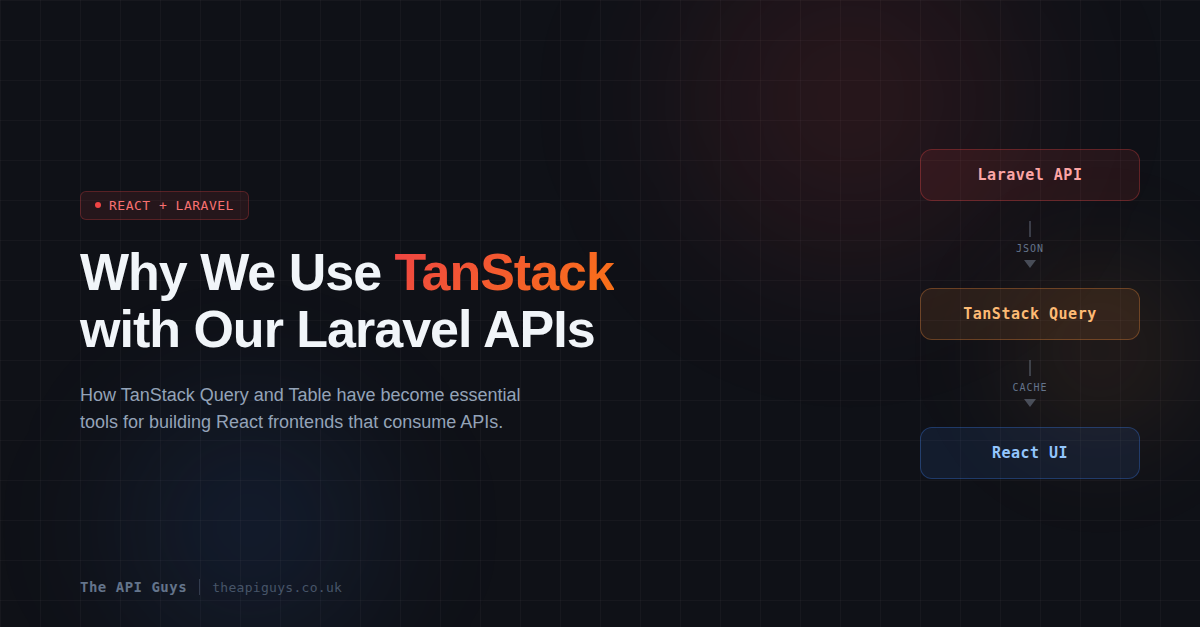
Why We Use TanStack with Our Laravel APIs
Your API is only as good as the frontend consuming it.
We spend a lot of time building clean, well-documented APIs with Laravel. Consistent responses, proper error handling, sensible pagination. But none of that matters if the frontend is fighting against the data layer instead of working with it.
That's why TanStack has become a core part of our React toolkit.
If you haven't come across it, TanStack is a collection of open-source libraries built by Tanner Linsley. The ecosystem has grown significantly over the past couple of years, but for us, the standout tools are TanStack Query and TanStack Table.
TanStack Query Changed How We Think About API Data
Before TanStack Query, consuming a Laravel API from a React frontend meant writing the same boilerplate over and over. useEffect calls, loading states, error handling, cache invalidation logic - all of it repeated across every component that needed data. It was tedious and it was fragile.
TanStack Query replaces all of that with a declarative approach. You tell it where to fetch data and how fresh it needs to be. It handles the caching, background refetching, retry logic, and synchronisation automatically. When we pair it with a well-structured Laravel API, the result is a frontend that feels instant and stays current without us writing state management code.
The practical benefits are significant. Duplicate requests are eliminated. Stale data is refreshed in the background. Optimistic updates make mutations feel immediate. And because it manages server state separately from client state, we don't need to shoehorn API responses into Redux or other global state libraries.
TanStack Table Solves the Data Table Problem Properly
If you've ever built a sortable, filterable, paginated table in React that pulls from an API, you'll know the pain. TanStack Table is headless - it gives you the logic without forcing any particular UI. We bring our own components and styling while it handles column definitions, sorting, filtering, pagination, and row selection.
Combined with TanStack Query and a Laravel API that supports proper query parameters for sorting and filtering, we can build complex data interfaces quickly and consistently.
The Ecosystem Keeps Getting Better
TanStack Router now offers fully type-safe routing for React applications, and TanStack Start reached its v1 release candidate last year as a full-stack React framework built on Vite. There's also TanStack Form for type-safe form management and TanStack DB for reactive client-side data storage.
We're not adopting everything at once - we pick the tools that solve real problems for us. But the direction of the ecosystem aligns well with how we build: type-safe, API-first, and with as little unnecessary abstraction as possible.
Where TanStack Fits in Our Stack
Our typical setup pairs a Laravel API backend with a React or Next.js frontend. TanStack Query sits between the two, managing the data lifecycle so our components stay clean and our API interactions stay predictable.
For data-heavy interfaces like admin dashboards and reporting tools, TanStack Table handles the presentation layer while Query manages the data fetching. The separation means we can swap out UI components without touching our data logic, and vice versa.
If you're building React frontends that consume APIs, TanStack Query alone is worth your time. It's one of those tools that makes you wonder how you ever managed without it.