Vercel Raises $300M at $9.3B Valuation - What It Means for Developers
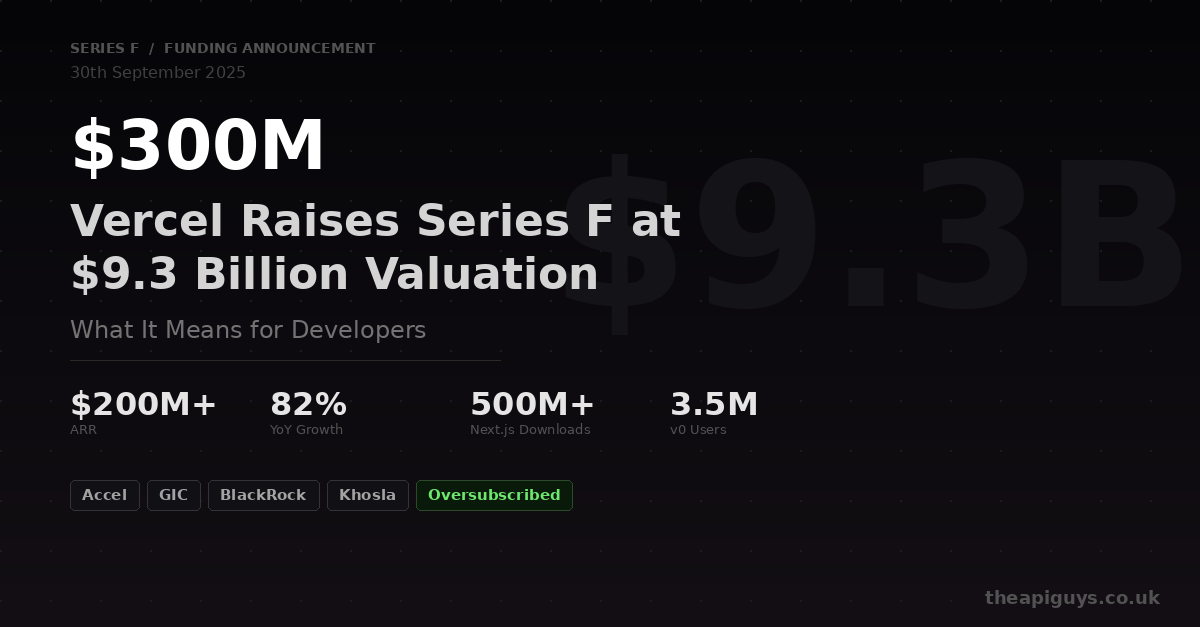
On 30th September 2025, Vercel announced the close of its Series F funding round, raising $300 million at a post-money valuation of $9.3 billion. The round was co-led by Accel and Singapore's sovereign wealth fund GIC, with new investors including BlackRock, StepStone, Khosla Ventures, Schroders, Adams Street Partners, and General Catalyst joining existing backers GV, Notable Capital, Salesforce Ventures, and Tiger Global.
That valuation is nearly triple where Vercel sat just 15 months earlier, when it raised $250 million at $3.25 billion in its Series E. The round was oversubscribed, and a separate $300 million secondary tender offer for early investors and employees is expected to close in November.
These are big numbers. But what does it actually mean for teams building on the platform?
The Numbers in Context
Vercel's annual recurring revenue surpassed $200 million by mid-2025, up from $100 million just 15 months prior. Revenue grew 82% year-over-year and the user base doubled. The AI SDK, their open-source toolkit for building AI-powered applications, now sees over 3 million weekly downloads, making it Vercel's fastest-growing open-source project. v0, the AI development agent, has reached 3.5 million users with enterprise accounts representing over 50% of its revenue.
Next.js itself was downloaded over 500 million times in the past 12 months, which is more than the total downloads from 2016 to 2024 combined. Major AI products including Claude, Grok, and Cursor use Next.js for their frontends. The framework's position as the default choice for React-based production applications looks more entrenched than ever.
The AI Cloud Pivot
The framing around this raise is firmly AI-focused. Vercel is no longer positioning itself primarily as a "Frontend Cloud." The messaging has shifted to the "AI Cloud," and the investment is intended to accelerate that transition.
Concretely, this means continued investment in the AI Gateway for unified model access, the AI SDK for building AI-powered features in TypeScript, Sandbox for running untrusted and AI-generated code safely, and Vercel Agent for automated code reviews and production investigations. These tools build on top of the infrastructure announcements from Vercel Ship 2025, particularly Fluid Compute and Active CPU pricing, which make the economics of running AI workloads on Vercel significantly more competitive.
Whether the "AI Cloud" label sticks or not, the underlying investment in compute, security, and developer tooling benefits everyone building on the platform, regardless of whether they are working with AI.
Leadership Changes
Vercel has also been strengthening its executive team through 2025, which signals the company is preparing for the next stage of enterprise growth. Notable hires include Jeanne Grosser as COO (previously Chief Business Officer at Stripe), Keith Messick as CMO (previously at Redis), Aparna Sinha as SVP of Product (previously Head of Enterprise AI/ML Products at Capital One), and Talha Tariq as CTO for Security (previously at IBM).
The security-focused CTO hire is particularly interesting. As security concerns around AI-generated code and "vibecoding" grew through 2025, Vercel positioned itself as a platform that takes these risks seriously. Built-in security for running untrusted code, bot management, and the broader security dashboard all point towards enterprise customers who need more than just fast deploys.
What This Means If You Build on Vercel
Funding rounds at this scale tend to mean a few things for the developer community. First, platform stability. A company with $300 million in fresh capital and $200 million in ARR is not going anywhere. If you are building production applications on Vercel, the platform's long-term viability is not a concern.
Second, expect continued investment in the developer experience. Vercel's growth has always been tied to making Next.js and the surrounding ecosystem better. That incentive structure does not change with this round, it gets stronger.
Third, pricing will be worth watching. Vercel has faced pushback from some enterprise users about bandwidth costs, and the Active CPU pricing model introduced at Ship 2025 suggests the company is willing to rethink its pricing structure. More competition for enterprise workloads typically benefits customers.
Fourth, the AI tooling will continue to mature quickly. The AI SDK, AI Gateway, and Sandbox are all relatively new products. With this level of investment behind them, expect rapid iteration and deeper integration into the core platform.
Our Take
A nearly 3x valuation jump in 15 months is remarkable, but it reflects genuine product momentum rather than hype. The download numbers for Next.js, the growth in enterprise adoption, and the traction of the AI SDK all point to a platform that developers are actively choosing. The investor list reads like a who's who of institutional capital, which brings both resources and pressure to deliver.
For us, the most meaningful signal is not the dollar amount but the direction. Vercel is investing heavily in areas that matter to production applications: compute efficiency, security, deployment safety, and developer tooling. Whether you use their AI products or not, those investments improve the platform for everyone.
Next.js remains one of our preferred frameworks for React-based projects, and this funding reinforces that it will continue to receive significant investment. If you are evaluating Vercel for a project or considering a migration, get in touch and we can help you assess whether it is the right fit.