Why Long-Term Support Matters When Choosing a Framework
When you evaluate a framework for a new project, it is natural to focus on features, performance, and developer experience. These things matter. But there is another factor that deserves equal weight in your decision and rarely gets it: how long will this framework be supported after you ship?
Every framework has a lifecycle. Major versions are released, maintained for a period, and eventually reach end of life. Once a version loses security support, any vulnerabilities discovered in it will not be patched by the maintainers. The CVEs keep coming, but the fixes do not. That is when your application starts accumulating risk with every passing week.
If you are making technology decisions for a business, the support policy behind a framework should be one of the first things you examine. It directly affects your maintenance costs, your security posture, and how much pressure your team will be under to upgrade on someone else's schedule.
Laravel's Support Model
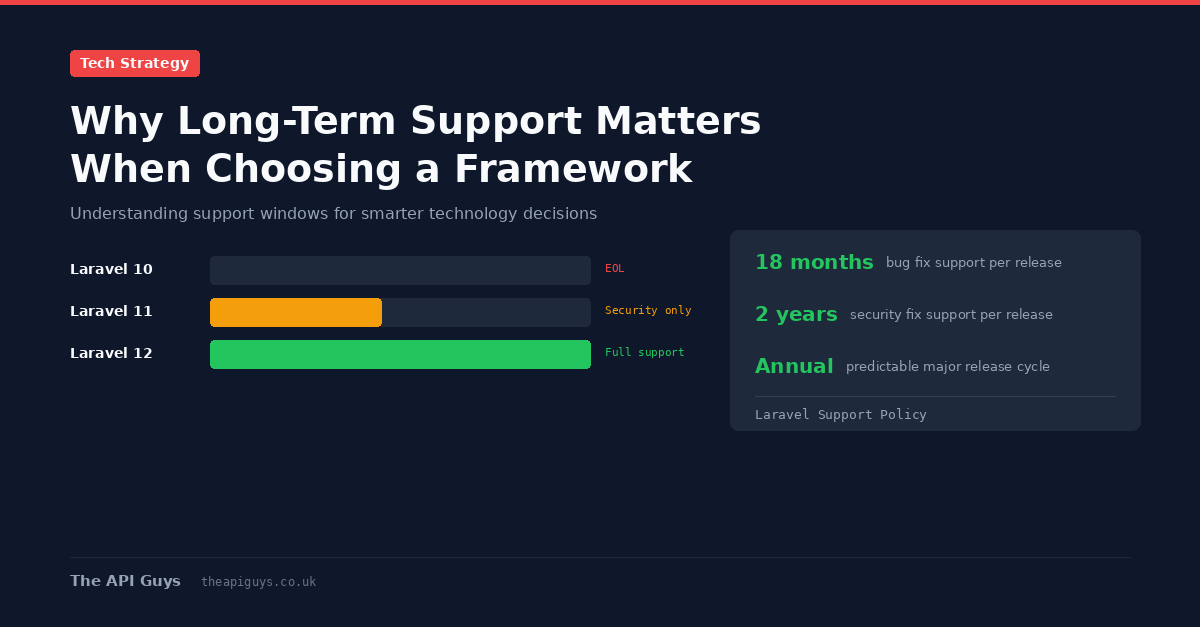
Laravel has one of the most transparent and predictable support policies in the PHP ecosystem. The rules are simple and have been consistent for years: every major version receives 18 months of bug fixes and 2 years of security fixes from its release date.
There is no ambiguity, no need to guess which versions will receive extended support, and no reliance on the goodwill of individual maintainers. You can look at the release date of any Laravel version and calculate exactly when it will stop receiving patches.
Here is what the current support landscape looks like as of mid-2025:
- Laravel 10 was released in February 2023. Its bug fix window closed in August 2024, and security support ended in February 2025. If you are still running Laravel 10 in production, you are running an unpatched framework.
- Laravel 11 was released in March 2024. Bug fixes continue until September 2025, with security fixes until March 2026. There is still time, but the clock is ticking.
- Laravel 12 was released in February 2025 and is the current major version. Bug fixes will continue until August 2026, and security support extends to February 2027. For new projects, this gives you the longest runway available.
This predictable cadence means you can plan your upgrade path before you even write your first line of code. If you start a project on Laravel 12 today, you know you have roughly two years of security coverage. You can build your maintenance schedule around that date rather than being caught off guard when support suddenly ends.
How Other Frameworks Handle Support
Laravel is not the only framework with a defined support policy, but the clarity and consistency of its approach stands out when you compare it to alternatives.
Django follows a feature release cycle of roughly eight months. Non-LTS releases receive support only until the next feature release ships, which gives you a relatively short window. Django does designate certain releases as Long-Term Support versions, and these receive security fixes for approximately three years. The catch is that you need to be on an LTS release to benefit from this extended support. If you adopt a non-LTS version, your support window is significantly shorter. This two-tier system means you need to be deliberate about which Django version you target.
Ruby on Rails does not publish a formal, versioned support policy in the same way Laravel and Django do. In practice, the Rails core team tends to maintain security patches for recent major versions, but the exact timelines are less predictable. This can make long-term planning more difficult, particularly for organisations that need to justify upgrade schedules to stakeholders who want concrete dates.
Node.js uses an even/odd versioning model where even-numbered releases become Long-Term Support versions with roughly 30 months of total maintenance. This is a generous window, but the broader Node.js ecosystem moves quickly. Many popular npm packages drop support for older Node.js versions well before the runtime itself reaches end of life. You might still be on a supported Node.js version but find that your dependencies no longer work with it, effectively forcing an earlier upgrade than the official timeline suggests.
None of this means one framework is objectively better than another. They serve different ecosystems and different communities. The point is that you should understand the support model before you commit to it, because it will directly affect your maintenance burden for years to come.
Why This Matters for Businesses
If you are building an internal tool that needs to run for three years, or a customer-facing application that will be in production for five, the support window of your framework determines how many major version upgrades you will need to perform during that period. Each major upgrade carries cost, risk, and engineering time.
With Laravel's annual major release cycle and two-year security window, a five-year application will likely require two to three major version upgrades. That is manageable, especially given that Laravel's upgrade paths are well-documented and the community provides tools like Laravel Shift to automate much of the process.
Compare that to a framework with shorter support windows or less predictable policies, and you may find yourself upgrading more frequently, with less tooling to help, and less certainty about when the next forced migration will arrive.
The cost equation is straightforward. Proactive upgrades performed on your schedule, with adequate testing time, are almost always cheaper and less risky than emergency migrations forced by a security advisory on an unsupported version. We covered this in detail in our earlier post on the hidden cost of ignoring security updates.
What You Should Check Before Adopting Any Framework
Regardless of which framework you are evaluating, here are the questions you should be asking before you commit:
What is the official support policy? Look for documented timelines covering bug fixes and security patches. If the framework does not publish a clear policy, that is itself a data point worth considering.
How long will your chosen version receive security fixes? This is the most critical window. Bug fix support ending is inconvenient. Security support ending is a risk.
How frequently are major versions released? Annual releases with smooth upgrade paths are very different from sporadic releases with significant breaking changes. The former lets you plan. The latter forces you to react.
What does the upgrade path look like? A framework with excellent tooling and documentation for upgrades will cost you far less in maintenance than one where each major version requires a significant rewrite.
What about the broader ecosystem? Your framework is only one layer. PHP, Node.js, Python, and Ruby all have their own support lifecycles. Your database, web server, and operating system do too. Every layer needs to be considered as part of your overall maintenance strategy, which is something we explored in our post on security patching is not a one-off task.
Why We Choose Laravel
We build APIs on Laravel because it is an excellent framework for that purpose. The routing, middleware, queue management, and ecosystem tools like Forge and Vapor make it a productive and reliable choice for the work we do.
But we also choose it because its support model aligns with how we think about long-term maintenance. We know exactly when each version will stop being patched. We can plan upgrades months in advance. We can give our clients clear timelines for when their applications will need to move to a newer version, and we can schedule that work during quiet periods rather than scrambling after a security disclosure.
That predictability has real business value. It means fewer surprises, fewer emergency deployments, and lower total cost of ownership over the life of an application.
The Bottom Line
The best time to think about framework support is before you start building. The features and developer experience will get you through the first few months of a project. The support policy will determine what the next few years look like.
If you are evaluating frameworks for a new project, or if you are running an application on a version that is approaching end of life, we would be happy to talk through your options. Get in touch and we can help you build a plan that keeps your application secure and maintainable for the long term.