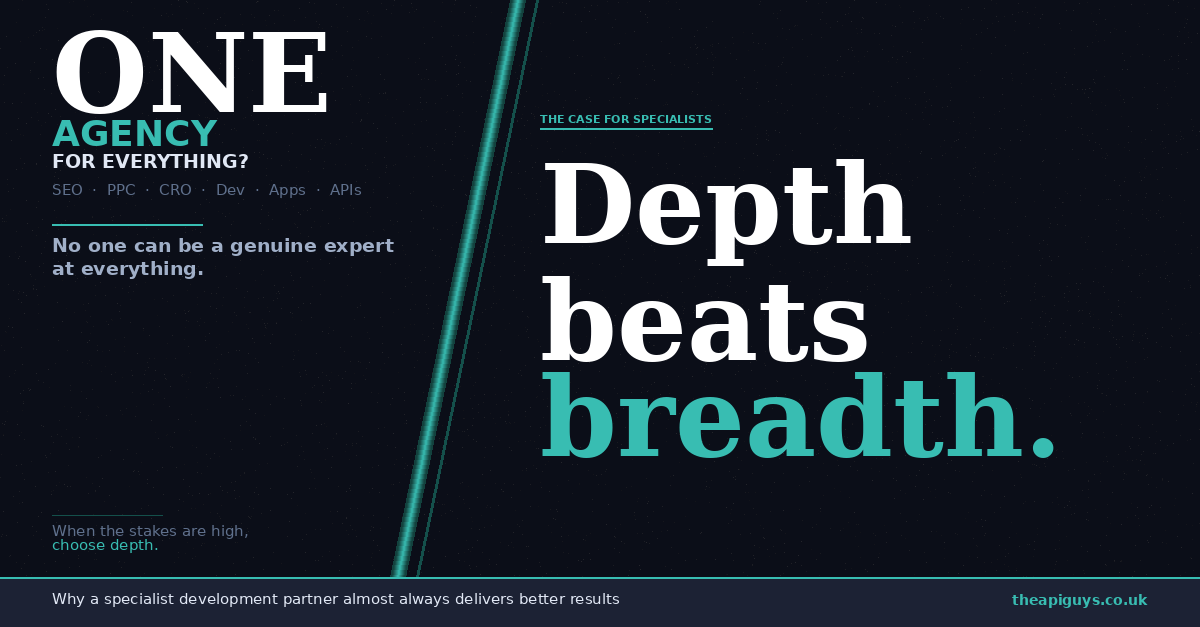
Why Specialist Agencies Often Beat Full-Service Ones
There is an appealing logic to the full-service agency model. One contract, one point of contact, one invoice. They handle your SEO, your PPC, your website, your bespoke software, your social media, and your CRO work. On paper, it simplifies everything.
In practice, it often does the opposite.
The Jack-of-All-Trades Problem
When an agency offers every digital service under one roof, something has to give. No team can be a genuine expert at paid search and bespoke API development and conversion rate optimisation and enterprise software architecture. The breadth is the problem. Each discipline is deep enough to be a full specialism in its own right, and the agencies that treat them all as equal offerings are spreading their talent dangerously thin.
That does not mean every person at a full-service agency is mediocre. Many have excellent individuals within specific teams. But the incentive structure works against you. When a single agency is billing you for ten different services, their attention, investment, and senior resource is always being divided. The squeakiest wheel gets the grease, and your bespoke development project may not always be the squeakiest wheel that month.
Software Development Is Not a Commodity Service
This matters most when it comes to software and API development specifically. Building bespoke applications is not like managing a Google Ads account. It requires deep technical knowledge, consistent architectural decision-making, and a team that lives and breathes the tools they use every day.
When a full-service agency takes on a development project, they are often pulling in a small development team - sometimes just one or two developers - who are also supporting other clients across other projects. The code that gets written reflects that context. Shortcuts get made. Architectural decisions get deferred. Security considerations get overlooked. And when something goes wrong six months later, you are back in the queue behind twelve other clients.
We have written before about the hidden cost of ignoring security updates - the kind of technical debt that accumulates when development is treated as a box-ticking exercise rather than an ongoing craft. Full-service agencies are more prone to this pattern because software maintenance simply does not fit neatly into their retainer model.
What You Gain from a Specialist
A specialist agency - whether that is a development studio, a paid media agency, or an SEO consultancy - has one job. Everything they do is in service of being genuinely excellent at that one thing. Their hiring, their tooling, their processes, their knowledge base, their team culture: all of it is oriented around depth rather than breadth.
For software and API development specifically, that depth translates into tangible outcomes. You get a team that has built similar systems before, that understands the failure modes, that keeps up with framework updates and security patches as a matter of professional habit rather than afterthought. You get people who will push back on a bad architectural decision rather than simply building what was spec'd, because they care about the long-term quality of the codebase.
You also get cleaner accountability. If your PPC and your website development are handled by the same agency and your conversion rate drops, it is genuinely difficult to unpick who is responsible and why. Separate specialist agencies provide clearer ownership and, as a result, clearer performance measurement.
But Can You Manage Multiple Agencies?
This is the fair objection, and it deserves a straight answer. Yes, working with multiple specialist agencies requires more coordination. You need a point of contact internally who can manage those relationships, ensure the agencies are aligned, and handle the occasional overlap.
For smaller businesses without that internal resource, a full-service agency can make practical sense - particularly if the work is relatively straightforward across all disciplines. We are not suggesting that full-service agencies are always the wrong choice. We are suggesting that when the stakes are higher, particularly for bespoke software, APIs, and digital infrastructure, the coordination overhead of working with a specialist is almost always worth it.
The alternative - discovering six months into a project that your full-service agency's development team does not understand API-first architecture, or has never dealt with the security requirements your application actually needs - is a far more expensive problem to unpick.
Questions Worth Asking Before You Sign
Whether you are evaluating a full-service agency or a specialist, these questions will tell you a lot about what you are actually buying:
- Who specifically will be working on our project, and what are their individual backgrounds?
- How many other clients is the development team currently supporting?
- What framework or stack do you use, and why? (Vague answers here are a red flag.)
- How do you handle security updates and ongoing maintenance after launch?
- Can we speak to a current client with a similar project to ours?
A specialist agency will answer these confidently and specifically. A generalist agency will often give you polished but evasive responses - because the honest answer is that it depends on who is available at the time.
Our View
We built The API Guys around a simple premise: do one thing and do it exceptionally well. Laravel API development, integration work, and the infrastructure that supports it. That focus means every project we take on benefits from the full depth of our team's expertise, not a fraction of it.
If you are evaluating development partners and want to understand whether a specialist approach is right for your project, get in touch. We are always happy to have an honest conversation about what your project actually needs - even if that means pointing you in a different direction.