Why Your Business Website Needs HTTPS in 2025 (It's Not Just About the Padlock)
If you run a business website in 2025 and it is still serving pages over plain HTTP, you have a problem. And it is bigger than you probably realise.
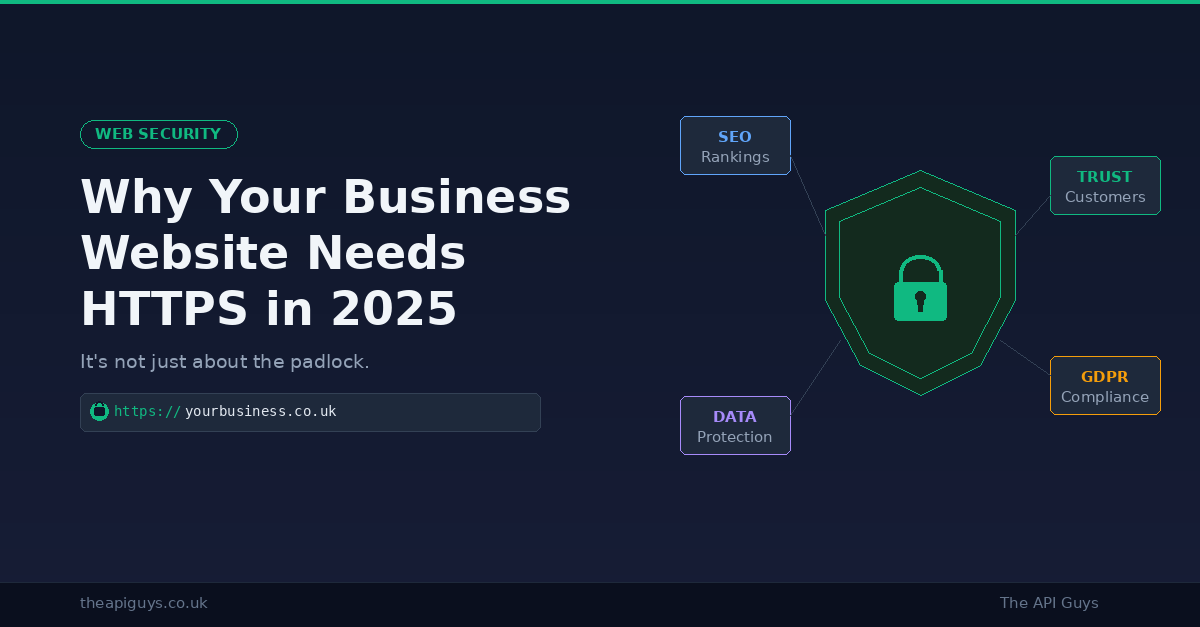
Most people associate HTTPS with the padlock icon in their browser's address bar. It is that small visual cue that tells visitors their connection is encrypted. But HTTPS is not just a cosmetic feature or something only e-commerce sites need to worry about. It affects your search rankings, your customers' trust, your legal obligations under UK data protection law, and increasingly whether browsers will even let people visit your site without a warning.
Here is why HTTPS should be treated as non-negotiable infrastructure for any business operating online.
What HTTPS Actually Does
Before diving into the business case, it is worth understanding what HTTPS provides at a technical level. HTTPS uses Transport Layer Security (TLS) to encrypt the connection between a visitor's browser and your web server. This encryption ensures three things: confidentiality (nobody can read the data in transit), integrity (nobody can tamper with the data without detection), and authenticity (the visitor can verify they are talking to your server and not an imposter).
Without HTTPS, everything a visitor does on your website travels across the internet as plain text. That includes form submissions, search queries, login credentials, and any personal information they enter. Anyone on the same network - a coffee shop's Wi-Fi, a hotel connection, or even a compromised ISP - can intercept and read that traffic.
This is not a theoretical risk. Man-in-the-middle attacks on unencrypted connections are well-documented and straightforward to execute with freely available tools.
Google Cares, and So Should You
Google confirmed back in 2014 that HTTPS is a ranking signal. Secure sites receive a small boost in search results compared to their HTTP equivalents. In the years since, that signal has only grown stronger as Google has pushed the web towards universal encryption.
But the ranking benefit is only part of the story. Since 2018, Google Chrome has marked all HTTP pages as "Not Secure" in the address bar. That warning appears regardless of whether your page collects any data at all. A simple brochure site, a blog, a portfolio - if it is served over HTTP, Chrome tells every visitor it is not secure.
Chrome holds roughly 65% of the global browser market. That means the majority of your visitors are seeing a security warning before they have even read your first paragraph. Firefox, Safari, and Edge have all adopted similar warnings. The result is the same: visitors leave, bounce rates increase, and your content never gets read.
Google has also announced that Chrome will begin defaulting to HTTPS-first behaviour, actively blocking connections to HTTP sites unless users explicitly choose to proceed. The direction of travel is clear. HTTP is being phased out of the modern web, and sites that have not migrated will find themselves increasingly isolated.
Trust is Everything Online
Consumer trust is fragile and hard-won. A "Not Secure" warning in the browser is one of the fastest ways to destroy it.
Put yourself in your customer's position. You search for a service, click through to a website, and the first thing you see is your browser telling you the site is not secure. Do you stay? Do you fill in the contact form? Do you enter your payment details? Most people do not. They click back and choose the next result - one that does not trigger a warning.
Studies consistently show that the majority of internet users will abandon a website that displays security warnings. For businesses that depend on online enquiries, lead generation, or e-commerce, this translates directly into lost revenue. Every visitor who bounces because of a security warning is a potential customer you will never hear from.
This is particularly damaging for smaller businesses and startups competing against established brands. When trust is the differentiator, a missing SSL certificate sends entirely the wrong message about your attention to detail and your approach to customer data.
UK GDPR and Data Protection
This is where things move from best practice to legal obligation. If your website collects any personal data from UK residents - and almost every business website does, whether through contact forms, newsletter signups, account creation, or analytics - you are subject to the UK General Data Protection Regulation and the Data Protection Act 2018.
The UK GDPR requires you to implement "appropriate technical and organisational measures" to protect personal data. The legislation explicitly names encryption as an example of an appropriate technical measure. The Information Commissioner's Office (ICO) has been clear in its guidance: if you are transmitting personal data over the internet, you should be using HTTPS.
The ICO's encryption guidance states that organisations should use HTTPS across all pages of their website, not just those that collect sensitive information. Their position is that there is no longer a compelling argument for not implementing HTTPS across an entire site. They also specify that you must not use any version of SSL (the predecessor to TLS), as all SSL versions suffer from known vulnerabilities. TLS 1.2 is the minimum acceptable standard, with TLS 1.3 strongly recommended.
Non-compliance is not a theoretical risk. The ICO has the power to issue fines of up to 17.5 million pounds or 4% of annual global turnover, whichever is greater, for serious data protection failures. While a missing SSL certificate alone might not trigger the maximum penalty, it demonstrates a fundamental failure to implement basic security measures - something the ICO will take into account if a data breach occurs.
If your website collects personal data over an unencrypted connection and that data is intercepted, you will have a very difficult time arguing that you took "appropriate technical measures" to protect it.
It Is Not Just About Forms
A common misconception is that HTTPS only matters for pages that collect sensitive data - login pages, payment forms, and the like. This is outdated thinking.
Even on pages that do not collect explicit user input, HTTP connections leak information. The URLs a visitor browses, the searches they perform on your site, the pages they view - all of this is visible in plain text on an unencrypted connection. For a healthcare provider, a legal firm, or a financial services company, the pages someone visits can be just as sensitive as the data they submit.
HTTPS also protects against content injection. On an HTTP connection, anyone between the visitor and your server can modify the page content in transit. This has been exploited by ISPs injecting advertisements into web pages, by attackers inserting malicious scripts, and by public Wi-Fi networks redirecting users to phishing pages. HTTPS prevents all of these attacks.
The National Cyber Security Centre (NCSC) aligns with this position, stating that all websites should use HTTPS regardless of whether they handle private content, login pages, or payment details.
The Cost Argument Has Disappeared
Ten years ago, there was a reasonable argument that SSL certificates were expensive and complicated to manage. Certificate authorities charged significant annual fees, installation required manual server configuration, and renewal was a process that could easily be forgotten until the certificate expired and your site went down.
That argument no longer holds. Let's Encrypt, launched in 2016, provides free, automated SSL certificates that are trusted by every major browser. The certificates renew automatically every 90 days with no manual intervention required. If you use a managed hosting platform or a tool like Laravel Forge, SSL provisioning is literally a single click.
Even if you manage your own servers, Certbot makes the process straightforward on any modern Linux distribution. There is no financial barrier, no significant technical barrier, and no legitimate reason to delay.
Common Excuses (and Why They Do Not Hold Up)
"My site does not collect any data." Your site almost certainly does, even if you do not realise it. Analytics tools, embedded fonts, contact forms, cookie consent banners - all of these involve data exchange. And as discussed above, even browsing behaviour constitutes personal data that should be protected.
"HTTPS slows down my site." This was marginally true a decade ago. Modern TLS implementations add negligible overhead. In fact, HTTPS is required for HTTP/2, the newer protocol that significantly improves page load performance. Migrating to HTTPS may actually make your site faster.
"It is too complicated to set up." With Let's Encrypt and modern server management tools, SSL configuration takes minutes. If your hosting provider makes this difficult, that is a strong signal to change providers.
"We will do it eventually." Every day your site runs on HTTP is a day you are losing search visibility, turning away potential customers, and exposing yourself to regulatory risk. There is no advantage to waiting.
Getting It Right
Installing an SSL certificate is the first step, but there are a few things to get right to ensure the migration is clean and effective.
First, ensure all HTTP traffic is redirected to HTTPS with 301 permanent redirects. This tells search engines that the secure version is the canonical URL and preserves your existing search rankings. Second, update all internal links, image sources, and script references to use HTTPS. Mixed content - where an HTTPS page loads resources over HTTP - will trigger browser warnings and partially undermines the security benefits.
Third, implement HTTP Strict Transport Security (HSTS). This header tells browsers to always connect to your site over HTTPS, even if someone types the HTTP URL directly. It prevents downgrade attacks and removes the brief window where a visitor might connect over HTTP before being redirected.
Fourth, check your TLS configuration. Use TLS 1.2 as a minimum, disable older protocols and weak cipher suites, and test your configuration with tools like SSL Labs' server test. A grade of A or above should be your target.
Finally, make sure your certificate renewal is automated. An expired certificate is worse than no certificate at all - it triggers an alarming full-page browser warning that will drive away even your most loyal customers.
The Bottom Line
HTTPS in 2025 is not a nice-to-have. It is foundational infrastructure that affects your search visibility, your customers' trust, your legal compliance, and the basic functionality of your website as browsers increasingly refuse to load HTTP content without warnings.
If your business website is still running on HTTP, the time to fix it is now. The certificates are free, the tools are mature, and the consequences of inaction - lost rankings, lost customers, and potential regulatory exposure - grow worse with every passing month.
As we discussed in our post on the hidden cost of ignoring security updates, keeping your infrastructure current is not just a technical concern - it is a business decision with real financial implications. HTTPS is one of the most straightforward security measures you can implement, and there has never been less reason to put it off.
If you are unsure whether your site is properly configured, or if you need help migrating to HTTPS and ensuring your web application meets current security standards, get in touch. It is one of the simplest things you can do to protect your business and your customers.